
North American box turtles can be found in large parts of Mexico, the United States and Southeastern Canada. Box turtles can generally be identified by their characteristic domed shell. In addition to the North American species, several Asian box turtle species live in East and Southeast Asia. This post provides and overview of all types of box turtles of the world with pictures and explanations.
Other types of turtles sometimes confused with box turtles are the Wood Turtles, the Musk Turtles and the Mud Turtles. These turtles either share similar type habitats or have hinges like box turtles.
The Convention of International Trade in Endangered Species of Fauna and Flora lists North American box turtles as an endangered species. Permits for their export and import are required. Many states protect their native box turtles and do not allow collection.
Box turtles are a long-lived species of reptiles with a low egg /clutch number, high hatchling mortality rate and ever-shrinking natural habitat. Their survival may depend on active conservation and research into their needs and demography.
North American box turtles
All North American box turtles belong in the Emydidae family of turtles. This large family also includes the sliders, map turtles and pond turtles from North American and Asia.
North American box turtles are separated from all the other turtles in this family into the genus, Terrapene. It contains 4 species, Terrapene carolina, Terrapene ornata and the rarely seen Terrapene nelsoni and Terrapene coahuila.
The most common box turtles found in the pet trade or along road sides and fields are the Common Eastern, Three-toed, Gulf Coast and Western Ornate box turtles. They each have a distinctive look but each subspecies seems to have individuals that are hard to identify.
Terrapene carolina – The Common box turtle
Terrapene carolina has 6 subspecies. The box turtles most commonly kept as pets are Terrapene carolina carolina, T. c. carolina or the Common Eastern box turtle, Terrapene carolina triunguis or the Three-toed box turtle and Terrapene carolina major or the Gulf Coast box turtle. Three other box turtles in this group are rarely seen as pets because they have small ranges or are difficult to maintain. They are the Florida box turtle or Terrapene carolina bauri, Terrapene carolina mexicana and Terrapene carolina yucatana.
The three common Terrapene carolina subspecies inhabit areas close to woodlands and forage on insects, worms, snails, slugs, fallen fruit and annual plants. The seeds of many plants like summer grapes, black cherries and pokeweed have a better germination percentage when they pass through the box turtle’s digestive tract. Box turtles may be an important agent for seed dispersal in the woodland ecosystem. Read more about the diet of box turtles and what to feed your turtle pet here.
The Common Eastern box turtle – Terrapene carolina carolina
The Common Eastern box turtle is 4-6 inches long with a high, domed shell and a low, middorsal keel. The carapace is usually dark brown with orange or reddish blotches of various size and shape that form an attractive pattern. The plastron may or may not have dark areas around the scute margins. The skin of the turtle is brown and the males have colorful scales on the front legs. They are found from Maine to Georgia and westward to Michigan, Illinois and Tennessee.
The Three-toed box turtle – Terrapene carolina triunguis

Threetoed box turtles are 3.5-5 inches long with a high-dome shell. The carapace is keeled and olive brown or yellowish brown and may or may not have markings of yellow . The markings are usually thin lines or spots and dashes. The plastron may or may not have dark areas. The skin is usually brown with yellow spots and the males have reddish heads with red, orange and black on the neck and forelegs. The beaks are also colorful. They usually have three toes on the hind feet but four toes are not uncommon. This subspecies may be found as far north as Missouri and southwards to Texas and Alabama.
If you want to learn more about Three-toed box turtles and how to take care of them, check out the article written by site founder Tess Cook that was published on the ReptileChannel.
The Gulf Coast box turtle – Terrapene carolina major

The Gulf Coast box turtle os 5-7 inches long with a dome shell. The shell is olive brown or dark brown and there is very little marking. The back marginal scutes are often flared outward forming a slope or skirt. This adaptation may help them walk the marshy ground during the Gulf Coast’s wet season. The plastron is usually unmarked. The skin can be light or dark brown and the males have colorful necks and forelegs. They can have three toes or four toes and are found in Gulf Coast areas of Texas, Louisiana, Alabama and western Florida.
Keel, plastron, carapace… Confused about the technical terms? Check out our box turtle glossary.
The Florida box turtle – Terrapene carolina bauri
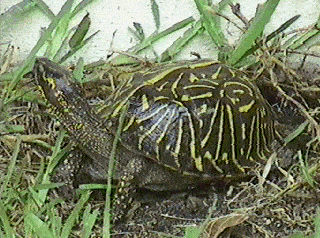
Florida box turtles are rarely kept as pets. They are found only in Florida and are 5 to 5 1/2 inches long and look similar in coloration to the Western Ornate. However the carapace is a high dome and the yellow starburst patterns are thinner and more numerous. There are two thick, yellow stripes on each side of the head going from the corner of the eyes towards the neck. The plastron is cream color with fine lines of brown.
The Mexican box turtle – Terrapene (carolina) mexicana
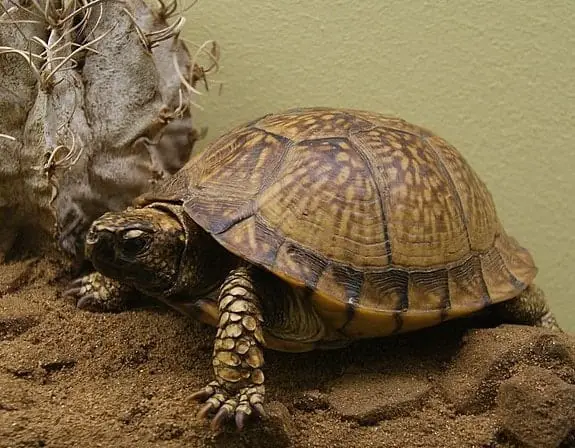
The Mexican box turtle is endemic to Northeastern Mexico around the area of San Luis Potosi. Mexican box turtles are rarely kept as pets. The scientific classification of the Mexican box turtle is not 100% clear. Some biologists consider it a sub-species of the Terrapene Carolina and some a species of the Terrapene genus.
The Yucatán box turtle – Terrapene (carolina) yucatana
As the name implies, the Yucatán box turtle is endemic to the Yucatán Peninsula in Eastern Mexico. The Yucatán box turtle has a light-colored shell with sometimes black dots on it. Its head has a yellowish color and the plastron is often a bright yellow. The Yucatán box turtle is not commonly used as a pet turtle. While most Terrapene box turtles have five toes on their feet, apart from the Three-toed box turtle, the Yucatán box turtle has four toes on each foot. Like the Mexican box turtle, it is sometimes directly classified as a species of the Terrapene genus and only sometimes considered a sub-species of the Terrapene Carolina.
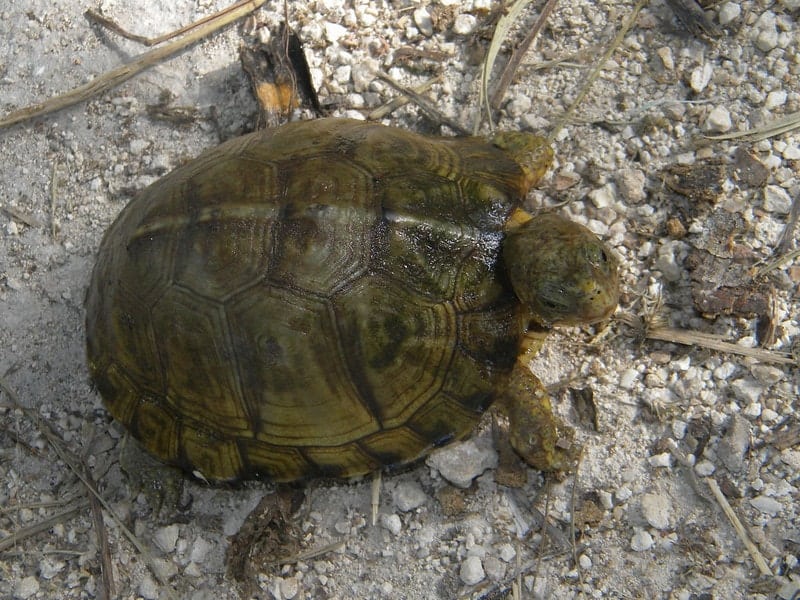
Terrapene ornata – the Western Ornate box turtle
The subspecies of turtles that belong to Terrapene ornata are Terrapene ornata ornata or the Western Ornate box turtle and Terrapene ornata luteola or the Desert box turtle. The Ornate box turtles are the most recently evolved box turtles and have many features that make them the most terrestrial. The Western Ornate box turtle is also often used as a pet turtle.
Western Ornate box turtles are found inhabiting open grassland and nonagricultural fields. Their ranges may have developed alongside the great herds of grazing animals on the North American Prairies. Their powerful front legs and strong claws are perfect for tearing apart manure piles in search of dung beetles and grubs. Studies have shown their numbers are reduced when cattle are removed from the Ornate box turtle’s home ranges.
The Western Ornate box turtle – Terrapene ornata ornata
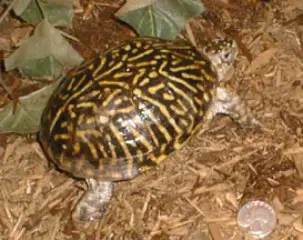
The Ornate box turtle is 4-5 inches long with a flattened-dome shell and no central keel, although a yellow midline is not uncommon. The shell is dark brown or black with bright yellow lines that radiate to form a starburst pattern.
The plastron is always marked with yellow and brown lines. The skin is dark gray and white and the head is dark brown with spots of white or yellow. The mature males obtain a greenish color on the top of the head. Ornate box turtles are found in grasslands of South Dakota through Illinois and southward to Arizona and Texas.
Desert box turtle – Terrapene ornata luteola
As the name would suggest, the desert box turtle can be found in Southwestern United States and Northern Mexico.
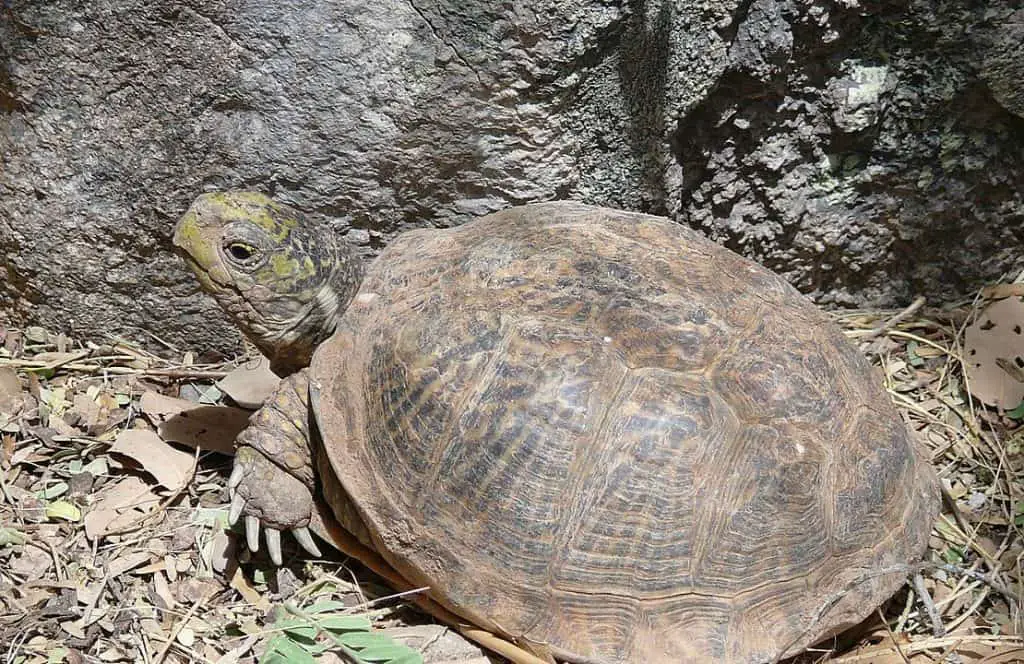
Like the Ornate box turtles, desert box turtles have yellow stripes on their shell. They live in grasslands and arid areas. If kept as a pet, you should make sure that the turtle has access to dry and soft soil where it can dig around as it is used to in its natural habitat.
While the desert box turtle is often kept as a pet, it is also an endangered species. Therefore, you should never remove a desert box turtle (or any other turtle) from the wild.
Spotted box turtle – Terrapene nelsoni
The specific name of the spotted box turtle, terrapene nelsoni, is in honor of the American naturalist and biologist Edward W. Nelson. There are two sub-species to the spotted box turtle: the Northern spotted box turtle and the Southern spotted box turtle. Both have a spotted dome – which has given them their common name.
Both spotted box turtle species are endemic to the Sierra Madre Occidental in Western Mexico. The spotted box turtle is not commonly kept as a pet turtle.
Coahuilan box turtle – Terrapene Coahuila
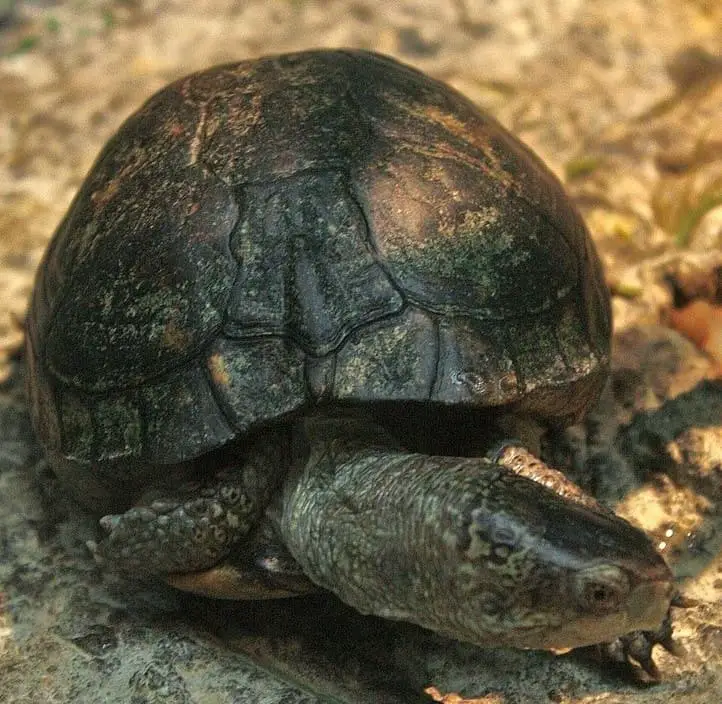
The Coahuilan or aquatic box turtle is native in the Northeastern Mexican state of Coahuila. This species of box turtle is hardly every seen in the pet trade and is, unfortunately, also endangered. The remaining number of Terrapene Coahuila is estimated at only 2,500 specimen. THankfully, the Mexican government has put strict laws in place to protect the species from extinction.
Unlike the other box turtle species, the Coahuilan box turtle spends a lot of time in or around water. Hence its second name, the aquatic box turtle.
Taxonomy of the North American Box Turtle
Order: Testudines
Sub-order: Cryptodira
Superfamily: Testudinoidea
Family: Emydidae
Sub-family: Emydinae
Genus: Terrapene
Sub-genera: Carolina, Ornata, Coahuila, Mexicana, Yucatana and Nelsoni
Asian box turtles
The Asian box turtles belong to the genus Cuora in the Geoemydidae Family. Formerly, they have been classified into the same Emydidae Family as the Terrapene. Asian box turtles are the most sold box turtles in the world. In China, they are collected and sold as a food item or they are shipped to the US or Europe as pet turtles. The turtle trade is putting several Asian box turtle species to the verge of extinction.
There are a total of 16 Asian box turtle species, of which four are already extinct. The box turtles of the Cuora genus are endemic in East Asia, mainly in Southern China and Southeast Asia.
The species Cuora flavomaginata and Cuora amboinensis are the most common Asian box turtles. Their common names are the Chinese box turtle or Yellow-margined box turtle and the Amboina or Malayan box turtle.
The Chinese box turtle – Cuora flavomaginata
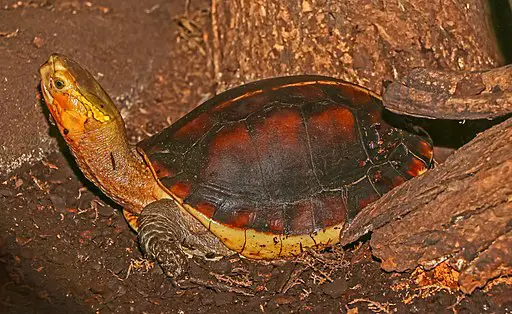
The Chinese box turtle, or Yellow-margined box turtle, is a box turtle species native in China, as the name suggests. It also has a yellow keel and one yellow strip along each side of the head that extends from the eyes. Its feet are usually dark.
The average Chinese box turtle reaches a length of 6 inches (around 15 cm).
Like most Asian box turtles, the Chinese box turtle is an endangered species due to the booming trade of turtle meat and pet turtles.
The Malayan box turtle – Cuora amboinensis
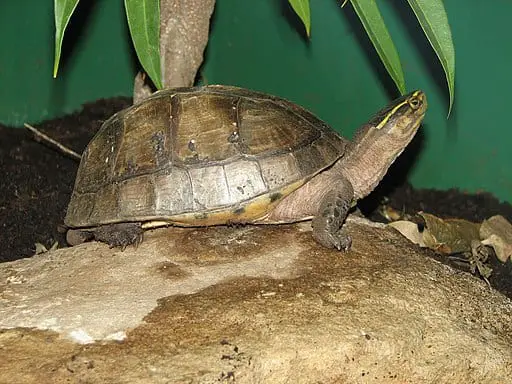
The Malayan box turtle, or Amboina box turtle, Malaysian box turtle or Southeast Asian box turtle can be found in various areas in Southeast Asia. There are four sub-species to the Malaysian box turtle. Their shell and head are dark green, nearly black colored. They can best be identified by three white-yellow stripes on their heads.
The Malayan box turtle lives around warm bodies of water and has never been seen in areas with temperatures below 70° F (21° F).
Taxonomy of the Asian box turtle
Order: Testudines
Sub-order: Cryptodira
Superfamily: Testudinoidea
Family: Geoemydidae
Sub-family: Geoemydidae
Genus: Cuora
Image text: All box turtles have a hinge (see picture on left by D. Senneke) on their bottom shell or plastron.
If you are interested in the different types of box turtles and their taxonomy, check out our further reading and resources page. There you can find interesting books, studies and online references to learn more about box turtles.
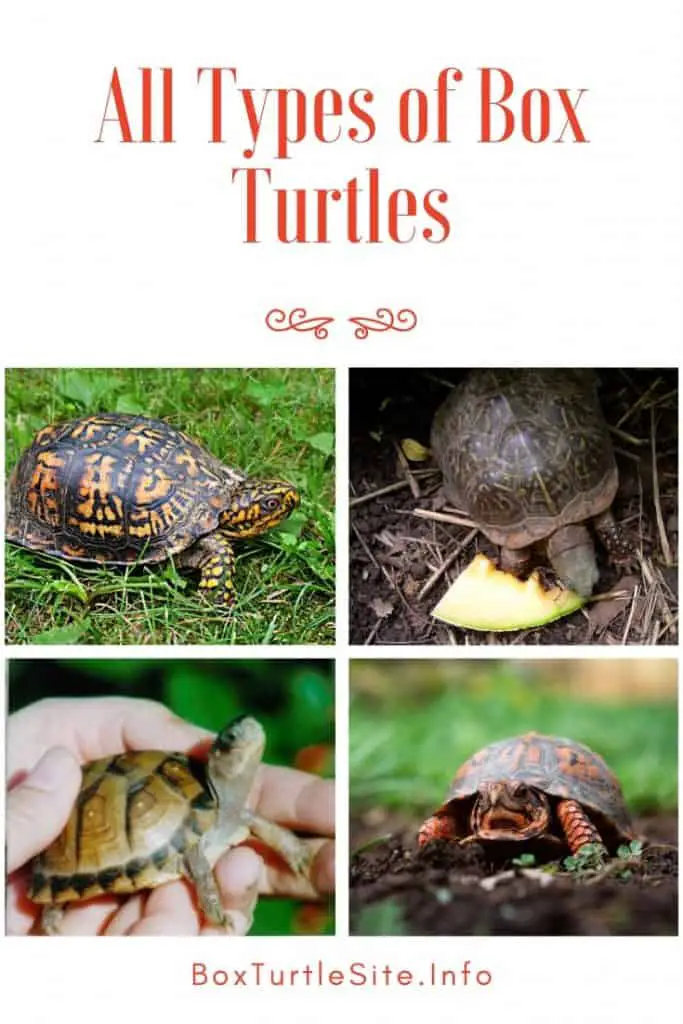
Pin this post for later by clicking on the picture below
7 thoughts on “Types of Box Turtles – Overview of Box Turtle Species”
Comments are closed.